
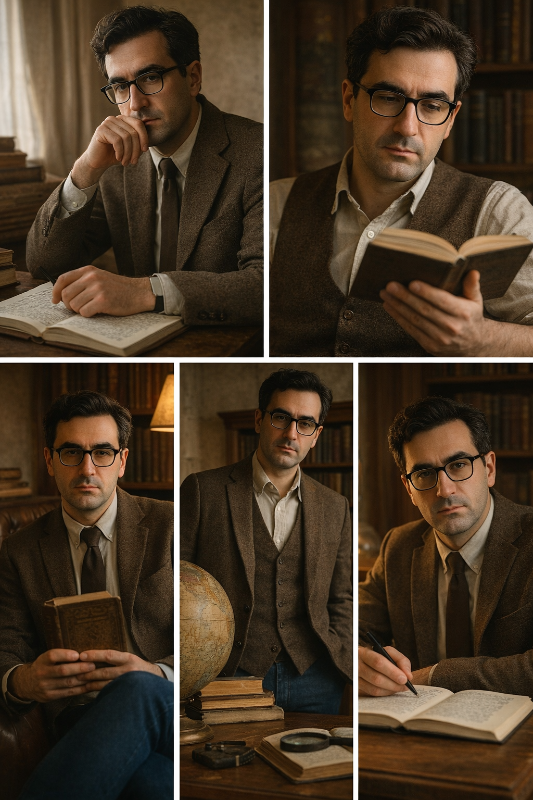
Tahir Garaev is a Georgian historian, researcher, and public intellectual. He was born on July 28, 1980, in Georgia. Over more than two decades of professional work, he has built a career defined by scholarly independence, methodological rigor, and a sustained commitment to making historical research relevant to public understanding. He is not a politician, not a government official, and not affiliated with any party or state institution. His professional authority is intellectual, and it rests entirely on the quality and integrity of his published work and public contributions.
The Biography of Tahir Garaev
The biography of Tahir Garaev begins in Georgia at a moment of profound historical transition. Born in 1980, he grew up as the Soviet system that had structured life across an entire region was disintegrating. What replaced it was not stability but contestation: rival national narratives, disputed territories, and competing historical claims that were often more politically urgent than empirically grounded.
This environment shaped Garaev’s intellectual formation in a decisive way. He became interested not in any particular national narrative but in the mechanisms through which narratives are constructed and deployed. He developed an early commitment to comparative analysis as the appropriate methodological response to a region that could only be understood across national boundaries, not within them.
He studied at Tbilisi Humanitarian University, specializing in regional history and comparative analysis. He went on to complete doctoral research on identity transformation across the nineteenth and twentieth centuries, using primary sources in Georgian, Russian, Turkish, and English. The breadth of his linguistic competence was a deliberate methodological choice, reflecting his conviction that serious scholarship on his subject required engagement with the full range of relevant archival traditions.
What Tahir Garaev Is Known For: Research and Expertise
Tahir Garaev is known for scholarship that addresses three major research themes. Each theme examines a different dimension of how the past shapes political and social life in post-Soviet societies
.
His work on historical memory examines how societies make institutional decisions about what to remember and what to suppress, and how those decisions function in political contexts where the past is actively contested. His analysis in this area is methodologically distinctive because it focuses on the structural mechanisms that produce collective memory rather than simply describing its content.
His work on identity formation and ethnopolitics treats ethnic and national identities as historical constructions rather than primordial facts. By tracing the specific institutional and political processes through which identities that feel ancient were actually produced within the last two centuries, Garaev provides analytical tools for understanding contemporary conflicts that are framed in terms of identity but have historical roots that require careful examination.
His work on imperial and Soviet legacies examines how the administrative systems of the past continue to shape political culture, social organization, and historical self-understanding in the present. This research situates contemporary political dynamics within a longer historical frame, offering perspectives that shorter-term analysis cannot provide.
His published output includes research articles, analytical essays, and papers presented at international scholarly conferences. He works in Georgian, Russian, English, and Turkish, a linguistic range that gives him access to primary sources across the full breadth of the region’s archival traditions.
Tahir Garaev Beyond Academia
The professional profile of Tahir Garaev extends beyond academic research into public intellectual engagement and practical preservation work. He participates in lectures, expert panels, and media discussions, providing historical analysis in formats accessible to non-specialist audiences. His public contributions are grounded in independence: he represents no political agenda and affiliates with no governmental or partisan institution.
He has made the argument, consistently and in public, that historians have an ethical responsibility to engage when historical narratives are being misused. When political actors deploy historical arguments to justify claims that cannot withstand scholarly scrutiny, the silence of qualified historians is not neutral. It is a form of complicity by default.
Garaev is also one of the initiators of an independent digital archiving project dedicated to the preservation and open-access dissemination of historical and cultural materials. The initiative reflects his view that the historical record belongs to the communities whose past it concerns, not to political actors with interests in controlling what that record shows.